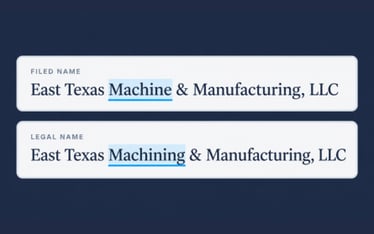

It’s Hard to be Specific without Being Too Specific.
Collateral Descriptions Are Tricky! We know strict compliance with Article 9 is vital in perfecting your security interest. Collateral descriptions can be a tricky business; don’t be too specific or too vague. Fortunately for one creditor, a bankruptcy judge deemed its collateral description as “sufficient”, even though it included a specific address.
What Makes a Collateral Description Sufficient?
According to Article 9-108, a collateral description is “sufficient” if it reasonably identifies the collateral. Whether the collateral is identified by specific listing, category, quantity, or “computational or allocational formula,” it doesn’t have to be perfect, if it’s enough to put other creditors on notice.
“What? It doesn’t have to be perfect?”
Gosh, it’s tough when speaking in terms of perfection. So, I’m calling on author Francis Buckley, Jr. to help me out –
“Fortunately, the policy behind the law governing secured transactions under the UCC explains financing statements are meant to simply provide notice of the transaction and give enough information to subsequent potential creditors that the debtor’s property may be covered by a prior creditor’s security interest. Essentially, a financing statement is meant to provide a starting point in a subsequent creditor’s due diligence process, not the conclusion.”
Oooooh, I like that! “…a financing statement is meant to provide a starting point in a subsequent creditor’s due diligence process, not the conclusion.”
Yes, ideally your Financing Statement should be perfect. But mistakes do happen and while some mistakes are costly, others are forgiven, as is the case in the 8760 Service Group case.
In 8760 Service Group, the secured creditor added what Buckley referred to as an “address restricter,” essentially adding the address to its collateral description:
“All Accounts Receivable, Inventory, equipment and all business assets, located at 1803 W. Main Street, Sedalia, MO 65301.”
A subsequent creditor argued the inclusion of an address left the Financing Statement seriously misleading and the security interest unperfected. But Judge Dow disagreed with the subsequent creditor. According to Judge Dow the “UCC does not require a perfect collateral description… only an ‘indication’ of such coverage…”
Here’s an excerpt from Francis Buckley Jr.’s It May Be Foul, But There Is No Harm: Not All Mistakes Have Dire Consequences Under UCC Article 9:
“In an interesting twist, Judge Dow found that the existence of an ambiguity in the collateral description of the financing statement did not prejudice the prior-filed creditor, but instead provided sufficient notice to the subsequent-filed creditor to impose a duty of further inquiry into the nature of the secured transaction covered under the financing statement. Judge Dow pointed out that the court does not employ traditional means of statutory construction in analyzing an ambiguous financing statement because the court does not proceed to interpret the language. Instead, the court inquires whether the financing statement sufficiently describes the collateral such that ‘the subsequent creditor should have been on notice to inquire further into the collateral.’”
Best Practice? Take Your Time & Draft Carefully
Frequently I see collateral descriptions that tend to be a bit more general: “…in all payment intangibles, accounts, accounts receivable owed to ABC Company…” (Unless, of course, it is related to a specific piece of equipment where serial numbers come into play.)
My advice is be careful when drafting the collateral description. Understand that if you include an address, it may be deemed as seriously misleading. Not to mention the potential catastrophe: what if there is no collateral at that address?! If you do include an address, keep tabs on your customer – make sure they don’t move the collateral to another location.
How to Get Payment Bond Information on a Federal Project
Need payment bond details for a federal construction project? Learn how to access this crucial information directly from the government & protect your payments.
Case Study: Hundreds of Projects. One Spreadsheet. A Better Way Forward.
Explore advanced lien tracking solutions tailored for seamless ERP integration. Boost productivity & simplify processes to effectively manage construction credit.
Podcast: Lien Waivers for Contractors & Subcontractors
Tune into our podcast with construction attorney Mark Grzymala to discover the types of lien waivers for contractors and subcontractors, when to sign, and more.