
7 min read
How UCC Name Errors Become Bankruptcy Risk: Case Example
Kristin Alford September 23, 2026
Key Summary
A UCC Financing Statement that doesn't match the debtor's legal name on file can be ruled seriously misleading and legally ineffective, and courts have voided secured interests over errors as small as a single word or an extra space. That risk becomes irreversible the moment a customer files bankruptcy, when an unperfected security interest isn't just weakened, it's eliminated outright.
Here's everything you need to know about how a UCC name error becomes bankruptcy risk:
- Why "Machining" versus "Machine" was enough to void a $500,000 secured claim in a January 2026 Texas bankruptcy case
- What makes a Financing Statement "seriously misleading" under UCC Article 9-506
- How 11 U.S.C. § 544(a)(1) lets a bankruptcy trustee eliminate an unperfected security interest entirely, rather than just subordinating it
- How to run a reflective search to catch a name error before it turns into a bankruptcy loss
The UCC filing system rewards precision. Courts have made that clear in case after case: a missing letter, an extra space, an abbreviated word where the full word belongs. A filing that doesn't match the debtor's name on the public organic record is seriously misleading under UCC Article 9-506, and a seriously misleading filing is ineffective.
Most creditors understand that much. What's less often discussed is what happens next, specifically, what happens when your customer files bankruptcy and your UCC has an error. The stakes in that scenario aren't just about priority. They're about survival.
A January 2026 decision from the United States Bankruptcy Court for the Eastern District of Texas illustrates exactly how that plays out.
How One Word in a UCC Filing Cost a Creditor $500,000
East Texas Machining & Manufacturing, LLC (ETMM) operated a metal and firearm manufacturing business in Henderson, Texas. In May 2020, STV Engine 001, LLC loaned ETMM $500,000, secured by a UCC-1 Financing Statement filed with the Texas Secretary of State.
UCC Debtor Name Error
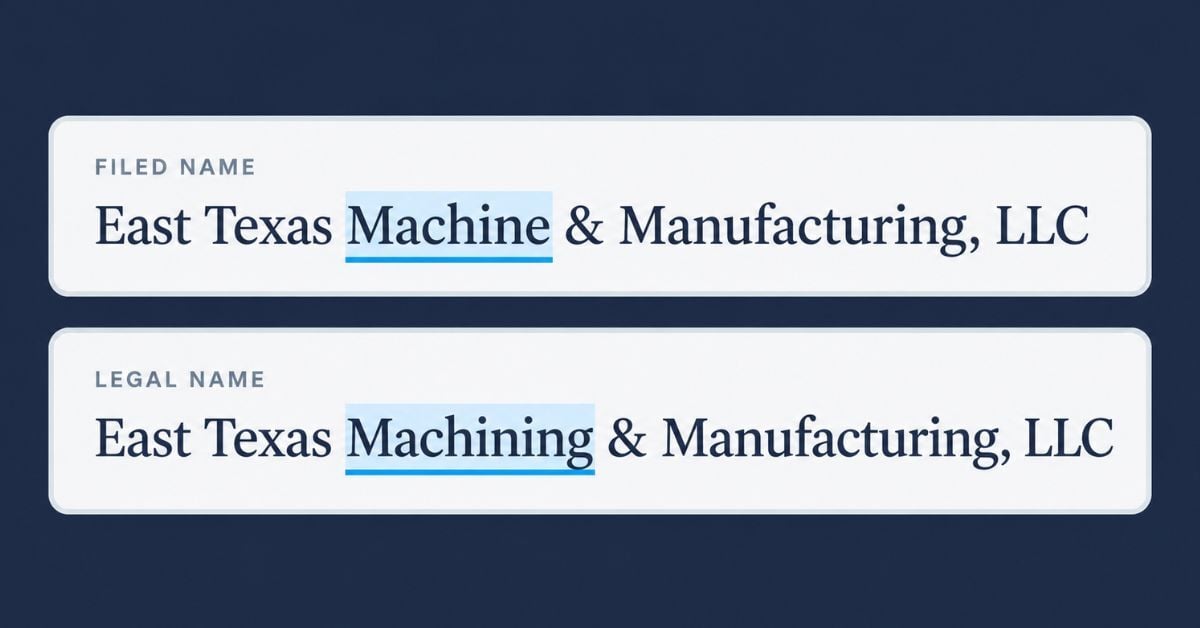
There was a problem with that filing. STV identified the debtor as "East Texas Machine & Manufacturing, LLC." ETMM's legal name, as it appears on its certificate of formation, is "East Texas Machining & Manufacturing, LLC." The difference is a single word: "Machine" versus "Machining."
In December 2023, ETMM filed for Chapter 11 bankruptcy protection. As the debtor-in-possession, ETMM filed an adversary proceeding against STV and moved for summary judgment on the grounds that STV's security interest was unperfected, invalid, and avoidable under federal bankruptcy law.
The court agreed. STV's $500,000 secured claim was avoided entirely, reducing it to an unsecured claim.
Why "Machining" vs. "Machine" Was Enough to Void the Filing
Under Texas Business & Commerce Code § 9.503(a)(1), a UCC Financing Statement is sufficient for a registered organization only if it provides the name on the organization's most recently filed public organic record, in this case, the certificate of formation. ETMM's certificate clearly states "East Texas Machining & Manufacturing, LLC." STV's filing did not.
UCC 9-506 and Seriously Misleading Filings
That alone brought § 9.506 into play. Under Texas law, a Financing Statement that fails to provide the debtor's name in compliance with § 9.503(a) is seriously misleading unless a standard search of the filing office's records under the correct name would still surface the filing. The court examined the Texas Secretary of State's UCC records: a search under ETMM's correct legal name did not return STV's Financing Statement. The safe harbor didn't apply. The filing was seriously misleading and therefore ineffective.
This isn't new legal territory. Courts have consistently held that even minor name errors, a missing letter, a punctuation difference, an abbreviated word, can be enough to render a filing seriously misleading. "Blvd." instead of "Boulevard" cost a Florida creditor its security interest. A missing letter did the same in other jurisdictions. A single extra space ended one Wisconsin creditor's secured status. The ETMM case adds one more data point to a long, consistent line of decisions.
What makes this case worth examining isn't the § 9.503 analysis. It's what happened after the filing was found ineffective.
Why an Unperfected UCC Filing Is Avoidable in Bankruptcy
When a customer files for bankruptcy, the legal landscape changes for every creditor in the case. For creditors holding unperfected security interests, it changes dramatically.
What 11 U.S.C. § 544 Does to Unperfected Security Interests
Under 11 U.S.C. § 544(a)(1), a bankruptcy trustee, or in a Chapter 11 case like this one, the debtor-in-possession, holds the same rights as a hypothetical judicial lien creditor who perfected a lien on the date the bankruptcy petition was filed. Texas law, like the law of every state, gives a perfected judicial lien priority over an unperfected security interest. The moment ETMM filed its Chapter 11 petition, it stepped into the shoes of a lien creditor with priority over any unperfected interest.
The court was direct: under Texas law, the moment a debtor files for bankruptcy, the debtor-in-possession becomes a lien creditor whose rights take precedence over those holding unperfected security interests.
Before vs Inside Bankruptcy: What Happens to an Unperfected Security Interest
Before bankruptcy, a creditor with a defective filing might lose priority to a later-perfecting creditor or a levying judgment creditor, but the security interest itself may still have some value depending on the circumstances. Inside bankruptcy, § 544(a)(1) doesn't subordinate the unperfected interest. It eliminates it. The court avoided STV's security interest in its entirety, leaving STV's $500,000 claim fully unsecured.
What Unsecured Means for Recovery
The word "unsecured" can sound abstract. It isn't. In a bankruptcy proceeding, secured creditors hold claims backed by specific collateral and are entitled to payment up to the value of that collateral, often before unsecured creditors see anything. Unsecured creditors, which include most trade vendors and now, STV, are paid from whatever is left after secured creditors and priority claims are satisfied. In many bankruptcy cases, that remainder is a fraction of the total owed, or nothing at all.
NCS has covered this dynamic before. In the Double Bubble case, a single extra space in the debtor's name ultimately meant recovery of roughly $113,000 on a $169,000 claim, versus full payment if the filing had been correct. In scenarios where a company's assets aren't sufficient to cover all unsecured claims, the gap between secured and unsecured recovery can be even wider.
The Reflective Search: Your Early Warning System
One of the clearest takeaways from ETMM, and from the body of case law around § 9.503, is that the filing office won't catch your mistakes for you. The Texas Secretary of State indexed STV's Financing Statement exactly as submitted. The error was invisible to anyone who didn't search under the incorrect name and compare results.
How to Perform a UCC Search after Filing
The reflective search closes this gap. After a UCC-1 Financing Statement is filed and recorded, run a search under the debtor's correct legal name, the name on the certificate of formation or applicable public organic record, and confirm your filing appears in the results. If it doesn't, you have a problem worth addressing while you still can. A UCC-3 amendment to correct a debtor name error is available, and it's far less costly than discovering the defect in bankruptcy court.
NCS Credit's UCC filing services include this review as part of the filing process, verifying the debtor name against the public organic record and confirming accurate indexing after filing.
Before You File
The ETMM decision is a useful reminder that compliance with UCC Article 9-503 isn't a formality. It's the foundation of a perfected security interest, and a perfected security interest is the foundation of your position in any collection or bankruptcy scenario.
For Registered Organizations
Confirm the debtor's exact legal name against the most recent public organic record for the jurisdiction where the organization is formed. That means the certificate of formation, articles of incorporation, or equivalent document, not the name on an invoice, a credit application, or a website. After filing, run the reflective search to confirm the Financing Statement appears under the correct name.
For Individual Debtors
That means the name on the unexpired driver's license, with attention to the Alternative A or B rules that apply in your state. The printed name on the license is the standard, not a nickname, a signature, or a commonly used variation.
The Bottom Line
STV lent $500,000 and held what appeared to be a secured position for more than three years. One word, "Machine" where it should have read "Machining," made that position legally worthless the moment ETMM filed for bankruptcy. The court had no discretion. The law left no room for equitable arguments about the error's practical significance or STV's obvious intent. Strict compliance is the standard, and bankruptcy is where the cost of falling short becomes final.
Questions about your UCC filing program? Talk to an NCS specialist.
Frequently Asked Questions
-
Can a UCC filing be voided for a name typo?
Yes. Under UCC Article 9-506, a Financing Statement that doesn't match the debtor's name on the public organic record is seriously misleading, and a seriously misleading filing is legally ineffective. Courts have voided filings over a missing letter, an abbreviated word, or even an extra space. In the ETMM case, the difference between "Machine" and "Machining" was enough to void a $500,000 secured interest.
-
What is the seriously misleading standard under UCC 9-506?
A Financing Statement is seriously misleading if it fails to state the debtor's name as required under 9-503(a). There's a safe harbor: if a search of the filing office's records under the debtor's correct legal name would still surface the defective filing, the error doesn't void it. If that search wouldn't turn up the filing, the safe harbor doesn't apply, and the filing is ineffective.
-
What does a bankruptcy trustee do with an unperfected security interest?
Under 11 U.S.C. § 544(a)(1), a bankruptcy trustee, or a debtor-in-possession in a Chapter 11 case, holds the same rights as a hypothetical judicial lien creditor who perfected a lien on the date the bankruptcy petition was filed. Since a perfected lien creditor outranks an unperfected security interest, the trustee can avoid the unperfected interest entirely, reducing it to an unsecured claim.
-
How do I verify my UCC-1 was filed correctly?
Run a reflective search after filing. Search the filing office's records under the debtor's exact legal name, the name on the certificate of formation for organizations or the unexpired driver's license for individuals, and confirm the Financing Statement appears in the results. If it doesn't, a UCC-3 amendment can correct the error before it turns into a problem in a bankruptcy or collection scenario.
-
Is a UCC-3 correction statement the same as a UCC-3 amendment?
No. They serve different purposes. A UCC-3 amendment changes the Financing Statement itself, so a correcting name amendment fixes the debtor name on the record from the date it's filed. A correction statement does something different. It's now called an information statement under UCC § 9-518 and is filed on a UCC-5. It lets a debtor, or a secured party of record, note on the public record that a filing is inaccurate or was wrongfully filed. It doesn't amend the original filing and has no effect on whether that filing is legally effective. If a debtor name error needs to be fixed, the UCC-3 amendment is the tool that does it.
-
What happens to an unperfected security interest in bankruptcy?
Outside bankruptcy, a creditor with a defective filing might lose priority to a later-perfecting or levying creditor, but the interest can still hold some value. Inside bankruptcy, § 544(a)(1) doesn't just subordinate the interest, it eliminates it. A secured claim becomes unsecured, paid only after secured creditors and priority claims are satisfied, often for a fraction of what's owed, sometimes nothing.
Do Mechanic’s Liens Expire? What Happens After
Understand the importance of enforcing your mechanic's lien claim. Learn about deadlines, suit processes, and how to protect your rights effectively.
Lien Index Q2 2026
Explore the latest Lien Index findings for Q2 2026, revealing trends in mechanic's lien activity and insights into construction industry credit risks.
Healthcare Bankruptcies Are Rising: A Risk to Suppliers
Healthcare bankruptcies are up 300%+ since 2010. See what unsecured creditors really recover — and how a UCC filing changes the outcome. Free download.