
Conditional, Unconditional, Time, and Money Construction Lien Waivers Explained
Lien waivers are routine on construction projects, signed and exchanged so often that it's easy to treat them as a formality. But the wrong waiver, signed at the wrong moment, can quietly waive lien rights a subcontractor or supplier was counting on. In this episode of the NCS Credit podcast, host Alec Papesch sits down with Mark Grzymala, founding attorney of Grzymala Law Offices in Skokie, IL, to break down the four main types of lien waivers, the role title companies play, and the practical steps credit teams can take to stop over-waiving their rights.
What You'll Learn about Construction Lien Waivers
Know the four waiver types and what each one releases.
Time waivers release rights through a date. Money waivers release rights only up to the payment received. Conditional waivers depend on the check actually clearing. Unconditional waivers take effect on signature, regardless of whether payment lands.
Partial and final are not the same as time and money.
Partial and final describe the stage of the project. Time and money describe the scope of the release. A partial waiver can be either a time waiver or a money waiver, and the same is true of a final waiver .
Common mistakes in lien waivers start with over-waiving rights.
Signing an unconditional time waiver before payment clears is the industry default in many cases, and it's where contractors lose the most ground. If the check bounces or never arrives, the lien rights are gone anyway. Our top lien waiver questions cover more of these everyday pitfalls.
Title companies usually require time waivers.
On larger projects with a title company managing draws, the standard form is almost always a waiver of lien to date. That's because owner statements, GC statements, and subcontractor statements all need to reconcile against each other for funds to be released.
A conditional waiver to the extent of payment is the strongest protection.
When the payment process allows for it, pairing a conditional waiver with a cashier's check or title company check at exchange is the cleanest way to protect rights without slowing down the project.
Read the contract before the project starts.
Many GC contracts on larger projects include a sample waiver form as part of the agreement. If that form is a waiver of lien to date, that's a term worth negotiating before signing, not after the first draw. Mark covered the same point from a different angle in our episode on price escalation clauses.
Technology is reducing the administrative load.
Modern construction credit software can generate the right waiver type from existing project data, cutting the time spent assembling and reviewing forms. As waiver volume keeps growing, that automation is becoming less of a nice-to-have and more of a baseline expectation.
Types of Lien Waivers
Before getting into the four waiver types, it helps to separate two distinctions that often get blurred. Partial and final describe when the waiver is signed (during progress payments versus at project completion). Waiver of lien to date and waiver to the extent of payment describe what scope of rights is being released (a date range versus a dollar amount). The two distinctions work together rather than interchangeably and getting them mixed up is one of the easiest ways to over-waive lien rights without realizing it.
Conditional vs Unconditional Lien Waivers
With that framework in place, there are two primary categories of lien waivers, each with two variations. A waiver of lien to date (also called a time waiver) waives lien rights up to a specific point in time. A waiver to the extent of payment (also called a money waiver) waives lien rights only up to the dollar amount actually received. Each can be conditional or unconditional, depending on whether the waiver takes effect when payment clears or the moment it's signed. The combination a contractor uses, and whether they understand what they're signing, has a direct effect on what's recoverable if a project goes sideways.
Lien waivers may look like routine paperwork, but every signature carries weight. The difference between a conditional waiver to the extent of payment and an unconditional waiver of lien to date can be the difference between recovering what's owed and absorbing the loss
NCS Credit Supports Lien Waiver Management
NCS Credit works with subcontractors, material suppliers, and credit teams across the country to help them manage lien waivers with the right structure, the right timing, and the right level of protection at every stage of a project. For a deeper dive into waiver mechanics, our lien waivers whitepaper is a good companion piece to this episode.
Consignment Agreements vs. Retail Bankruptcy: UCC Advantages
Retail bankruptcies are rising and consignment agreements alone won't protect you. Learn what Article 9 requires and why a UCC filing is your most important step.
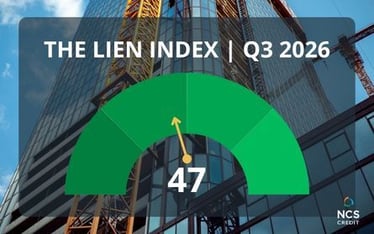
Lien Index Q1 2026
Lien Index news for Q1 2026: mechanic's lien activity declines to its lowest reading since 2022 as construction pipelines soften across key sectors.
Case Study: When Your Process Can't Keep Up with Your Growth
Outgrown your preliminary notice process? See how a major construction supplier automated its workflow, saved 50+ hours a week, and never missed a deadline.